In this guide
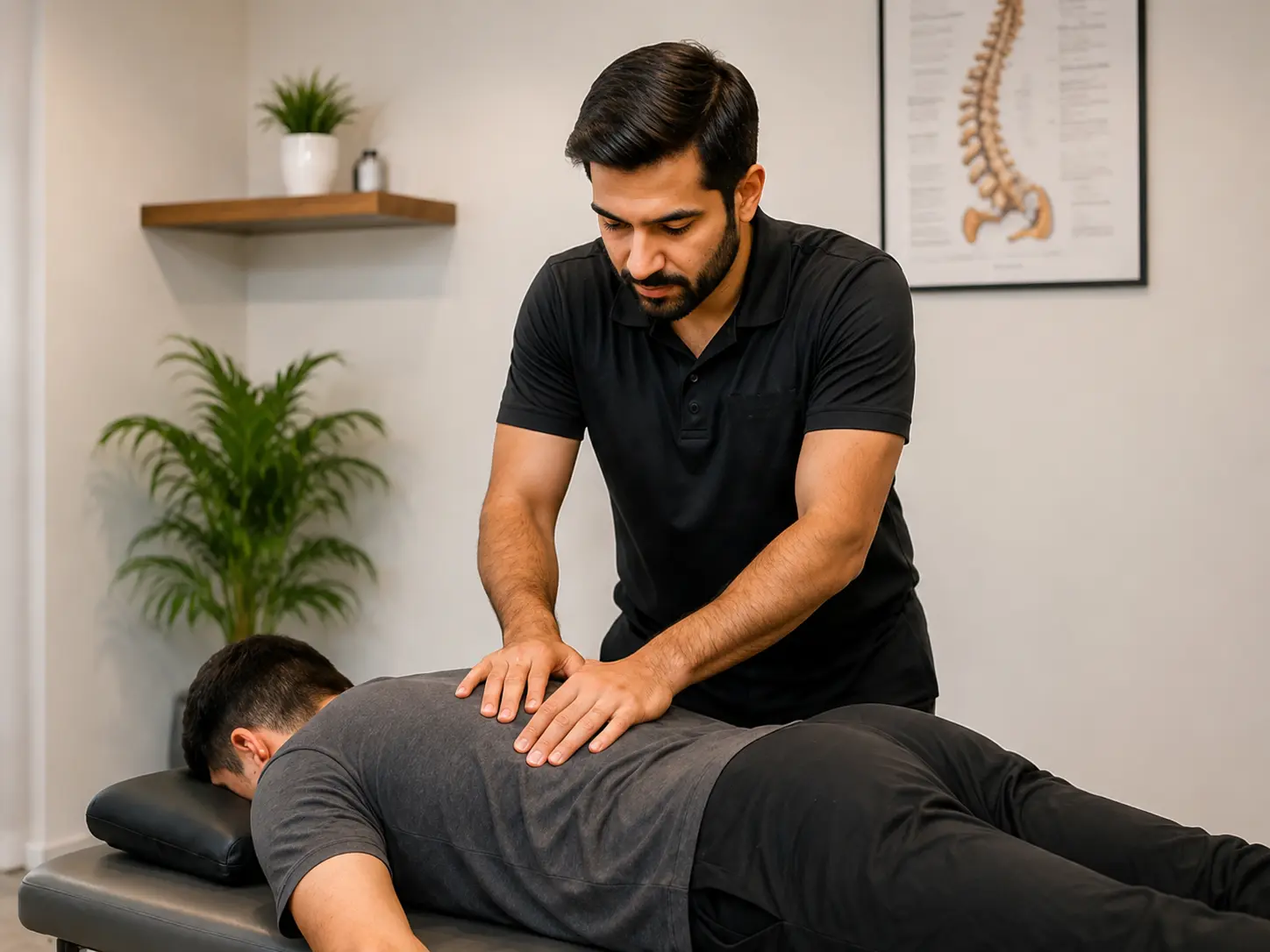
Representative service imagery.
An MRI report can change how you think about your back in a few minutes. Before the scan, you had pain while sitting or symptoms down a leg. Afterwards, you may also have words such as “disc bulge,” “protrusion” or “herniation” to worry about. It is understandable to wonder whether bending, working or exercising is still safe.
Physiotherapy for a disc bulge begins with putting those words into context. Your report matters, but so do your symptoms, examination findings and everyday abilities. The useful question is not simply what the scan calls the disc. It is what the finding means for your situation, and what care is appropriate next.
Symptoms that require emergency assessment
Go to the nearest hospital emergency department immediately if back pain occurs with new numbness around the genitals, bottom or between the legs; difficulty starting urination or inability to urinate; loss of bladder or bowel control; or a new loss of sensation when passing urine or a bowel movement. These can be warning signs of cauda equina syndrome, which needs urgent assessment. The Worcestershire Acute Hospitals NHS Trust's cauda equina guidance explains the warning symptoms and the need for immediate hospital attendance.
Emergency care is also needed when back pain follows a major accident, is accompanied by chest pain, affects both legs with pain, pins and needles, weakness or numbness, or occurs with a new change in sexual sensation or function. The NHS back-pain guidance identifies these circumstances. The NHS slipped-disc advice additionally directs people with back pain and newly lost sensation in either leg, or both, to emergency care. Do not wait for an ordinary clinic booking or a WhatsApp response when these symptoms are present.
What do “slipped disc” and “herniated disc” mean?
Discs are cushions of tissue between the bones of the spine. The everyday phrase “slipped disc” is also used for a prolapsed or herniated disc. The NHS explains that a disc extending outwards can cause symptoms if it affects nerves, but some people have disc changes without symptoms.
For this article, the focus is on lower-back disc findings and their relationship to back or leg symptoms. A cervical disc finding needs assessment of the neck and relevant arm or neurological symptoms instead. Neither should be diagnosed from an online article.
Why a scan is only part of the assessment
A systematic review of spinal imaging in people without symptoms found that degenerative changes, including disc bulges, can be present in pain-free individuals and become more common with age. That finding helps explain why an MRI result alone cannot identify the source of an individual's pain.
This does not establish that your finding is irrelevant. A review of pain-free people cannot determine whether a finding matters in your individual case. That requires clinical interpretation.
Ask how the report relates to the side and pattern of your symptoms, examination findings and function. If the connection remains uncertain, ask what further information would change the decision.
Do you need another MRI before physiotherapy?
NICE's guideline on low-back pain and sciatica advises against routine imaging in non-specialist settings and recommends considering imaging in specialist care when the result is likely to change management. A clinician should decide whether imaging is needed in your particular circumstances, including when serious causes are suspected.
If you already have a scan, bring it with any specialist advice. If you do not, an assessment can discuss whether it is relevant; a scan is not automatically the first step for every person seeking help with back or leg pain.
What a disc-related physiotherapy assessment explores
At ThriveX Physio, disc bulge and herniation rehabilitation considers the imaging alongside your symptom pattern, movements and positions that change symptoms, current strength and walking tolerance, and activities you are avoiding. The aim is to understand what your back currently allows and what you want to return to.
The symptoms that matter to you
Describe where symptoms start and where they travel. Explain whether sitting, standing, walking or a particular task is difficult. Mention numbness, tingling or weakness, any change since a previous medical appointment, and what other clinicians have told you.
Try to give examples rather than only a pain score. “I stop halfway through the journey to work” gives different information from “my pain is seven out of ten.” Both may be useful, but the first helps identify a practical problem the plan needs to address.
Your current abilities
Discuss which tasks are necessary and which can be adjusted temporarily. Ask how the clinician distinguishes a manageable response from a reason to stop and seek reassessment. Those boundaries need to be clear before you leave, particularly when leg symptoms are involved.
The activities you have stopped
Sometimes the report creates new uncertainty even about activities that were previously manageable. Bring those concerns into the conversation. You may be avoiding lifting groceries, playing with children or travelling because you do not know what is sensible.
Ask the clinician to explain the reasoning behind any restriction. A useful recommendation tells you what it is trying to achieve, when it will be reviewed and what information would change it. You should not have to interpret a scan report as a permanent list of forbidden movements.
Where active rehabilitation fits
NICE recommends information tailored to the person, support for normal activity and consideration of an exercise programme that takes account of individual needs, preferences and abilities. It considers manual therapy only within a package that includes exercise and advises against traction for low-back pain with or without sciatica. These recommendations are set out in NG59.
ThriveX's disc rehabilitation focuses on restoring confident movement and building tolerance gradually, guided by your response rather than the scan alone. The assessment determines the plan. This is different from assuming everyone with the same MRI term needs the same movements.
There is no exercise prescription in this article. Ask what you should practise, how you should judge the response, and when to contact the clinician. Rehabilitation is also not a promise to push a disc back into place or erase an imaging finding. The relevant discussion concerns symptoms, function and the next appropriate step.
How should progress be judged?
Agree on a small number of practical markers at the outset. They might include completing a necessary walk, tolerating a work task, or returning to an activity you value. ThriveX's assessment includes current movement, strength and walking tolerance, so ask which of these will be reviewed for your particular goal.
A progress review should also cover concerns that have appeared since the last appointment. If the plan is not helping you work towards the agreed goal, ask what will change and whether a medical opinion is needed. Continued appointments should have a purpose you understand.
When medical review may be needed
The NHS slipped-disc guidance recommends medical review when symptoms are not improving and explains that worsening weakness or numbness can warrant a specialist discussion. Tell the clinician about new or changing symptoms rather than waiting for a planned rehabilitation review.
Seek urgent medical advice for back pain when you feel feverish, shivery or generally unwell, or when severe pain begins suddenly or worsens quickly. Arrange medical review for unexplained weight loss or pain that is worse at night. These distinctions are set out in the NHS back-pain guidance. Emergency symptoms listed above need immediate hospital care.
Questions to bring to your appointment
Take your scan report, previous advice, relevant medical history and a short account of the activities you find difficult. You can then ask:
Which parts of my report are relevant to the symptoms I have?
What did the examination show, and what remains uncertain?
What is the first practical goal of the plan?
How should activity be progressed or adjusted?
Which changes need medical advice or emergency care?
How will we decide whether rehabilitation is helping?
If you have been given contradictory advice, bring it with you. Ask the clinician to explain the difference and whether your circumstances have changed.
Common questions
Is slipped-disc physiotherapy different from herniated-disc physiotherapy?
People use these terms in overlapping ways. The name used in conversation does not determine your programme. Your exact report, symptoms, examination and goals guide the assessment and the decision about suitable care.
Does a disc bulge always need surgery?
No. The NHS states that surgery is not usually needed, although persistent symptoms or worsening weakness or numbness can warrant a specialist discussion. Emergency neurological symptoms need urgent hospital assessment; they should not be managed by waiting to see whether routine physiotherapy helps.
Can you predict my recovery from the report?
A report does not provide a reliable personal timetable by itself. Ask what the assessment suggests, what the immediate goals are and when progress will be reviewed. A precise recovery promise based only on the words “disc bulge” leaves out too much of your situation.
Arrange an assessment in Islamabad
Learn about ThriveX's disc bulge and herniation rehabilitation or contact the clinic to discuss an assessment. ThriveX Physio is at Allegiance Tower, near F-9 Park, in New Blue Area, Islamabad. For routine enquiries, you can message the clinic on WhatsApp.
Evidence & further reading
Guidance and research behind this article. Each source is linked so you can read its context and limits. Some guidance comes from UK or US health services; local referral and emergency pathways in Pakistan differ.
- NHS: slipped disc
Disc definition and overlapping terminology; some findings are asymptomatic; emergency care for back pain with lost sensation in one or both legs; medical/specialist review for persistent symptoms or worsening weakness/numbness; surgery is not usually needed.
- NICE NG59: low back pain and sciatica recommendations
Recommendations 1.1.4-1.1.6 on imaging, 1.2.1-1.2.2 on tailored advice/activity/exercise, 1.2.6 on traction, and 1.2.7 on manual therapy as part of an exercise package. No reliance on psychological recommendations removed in July 2026.
- Brinjikji et al. (2015): systematic review of imaging features in asymptomatic populations
Degenerative spine imaging findings including disc bulges occur among asymptomatic individuals and become more common with age; findings require clinical interpretation.
- NHS: back pain
Emergency assessment for back pain with chest pain, serious trauma, bilateral leg neurological symptoms or sexual changes; urgent medical advice for fever/unwellness or sudden severe/rapidly worsening pain; medical review for unexplained weight loss/night pain.
- Worcestershire Acute Hospitals NHS Trust: cauda equina syndrome
Saddle sensory loss, urinary initiation/retention/incontinence and bowel sensation/control changes; immediate emergency department attendance for new symptoms.